Question
Gustation
Question
to analyze the chemical components of food that come in contact with the receptor cells. • Act as screening mechanism for potentially harmful compounds.
Question
peripheral organ in the gustatory system
Question
Irregularities elevations in the dorsal surface of the tongue.
Question
cluster of small mucous-membrane projections
Question
4 taste papillae
Question
No taste buds texture
Taste
 TestMaker
Score
0 / 10
Correct rate
0%
Correct: 0
Incorrect: 0
Unanswered: 10
Sporeformers

Sporeformers
Tameyra Stefani Al-Suhairy · 44 questions · 2 y agoSporeformers
Sporeformers
44 questions • 2 y agoSpirochetes
Spirochetes
Tameyra Stefani Al-Suhairy · 46 questions · 2 y agoSpirochetes
Spirochetes
46 questions • 2 y agoSubcutaneous, Systemic, Opportunistic Mycoses
Subcutaneous, Systemic, Opportunistic Mycoses
Tameyra Stefani Al-Suhairy · 75 questions · 2 y agoSubcutaneous, Systemic, Opportunistic Mycoses
Subcutaneous, Systemic, Opportunistic Mycoses
75 questions • 2 y agoMycobacteria
Mycobacteria
Tameyra Stefani Al-Suhairy · 46 questions · 2 y agoMycobacteria
Mycobacteria
46 questions • 2 y agoBacterial Classification, morphology, utrastructure
Bacterial Classification, morphology, utrastructure
Tameyra Stefani Al-Suhairy · 64 questions · 2 y agoBacterial Classification, morphology, utrastructure
Bacterial Classification, morphology, utrastructure
64 questions • 2 y agoHIV
HIV
Tameyra Stefani Al-Suhairy · 31 questions · 2 y agoHIV
HIV
31 questions • 2 y agoCORONA
CORONA
Tameyra Stefani Al-Suhairy · 24 questions · 2 y agoCORONA
CORONA
24 questions • 2 y agoPAPILLO
PAPILLO
Tameyra Stefani Al-Suhairy · 15 questions · 2 y agoPAPILLO
PAPILLO
15 questions • 2 y agoADENO
ADENO
Tameyra Stefani Al-Suhairy · 16 questions · 2 y agoADENO
ADENO
16 questions • 2 y agoPOX
POX
Tameyra Stefani Al-Suhairy · 6 questions · 2 y agoPOX
POX
6 questions • 2 y agoPARVO
PARVO
Tameyra Stefani Al-Suhairy · 25 questions · 2 y agoPARVO
PARVO
25 questions • 2 y agoHEPATOTROPHIC
HEPATOTROPHIC
Tameyra Stefani Al-Suhairy · 24 questions · 2 y agoHEPATOTROPHIC
HEPATOTROPHIC
24 questions • 2 y agoPICORNA
PICORNA
Tameyra Stefani Al-Suhairy · 25 questions · 2 y agoPICORNA
PICORNA
25 questions • 2 y agoRABIES
RABIES
Tameyra Stefani Al-Suhairy · 26 questions · 2 y agoRABIES
RABIES
26 questions • 2 y agoPARAMYXO
PARAMYXO
Tameyra Stefani Al-Suhairy · 20 questions · 2 y agoPARAMYXO
PARAMYXO
20 questions • 2 y agoHERPES
HERPES
Tameyra Stefani Al-Suhairy · 40 questions · 2 y agoHERPES
HERPES
40 questions • 2 y agoORTHO
ORTHO
Tameyra Stefani Al-Suhairy · 7 questions · 2 y agoORTHO
ORTHO
7 questions • 2 y agoFLAVI
FLAVI
Tameyra Stefani Al-Suhairy · 24 questions · 2 y agoFLAVI
FLAVI
24 questions • 2 y agoTOGA
TOGA
Tameyra Stefani Al-Suhairy · 19 questions · 2 y agoTOGA
TOGA
19 questions • 2 y agoVIRUS STRUCTURE
VIRUS STRUCTURE
Tameyra Stefani Al-Suhairy · 16 questions · 2 y agoVIRUS STRUCTURE
VIRUS STRUCTURE
16 questions • 2 y agoNormal Flora
Normal Flora
Tameyra Stefani Al-Suhairy · 61 questions · 2 y agoNormal Flora
Normal Flora
61 questions • 2 y agoBacterial physiology, growth, nutrition
Bacterial physiology, growth, nutrition
Tameyra Stefani Al-Suhairy · 63 questions · 2 y agoBacterial physiology, growth, nutrition
Bacterial physiology, growth, nutrition
63 questions • 2 y agoNeisseria & Corynebacterium
Neisseria & Corynebacterium
Tameyra Stefani Al-Suhairy · 27 questions · 2 y agoNeisseria & Corynebacterium
Neisseria & Corynebacterium
27 questions • 2 y agoMycology, superficial,cutaneous mycoses
Mycology, superficial,cutaneous mycoses
Tameyra Stefani Al-Suhairy · 31 questions · 2 y agoMycology, superficial,cutaneous mycoses
Mycology, superficial,cutaneous mycoses
31 questions • 2 y agoParasitology (Protozoa, Cestodes, Nematodes, Trematodes)
Parasitology (Protozoa, Cestodes, Nematodes, Trematodes)
Tameyra Stefani Al-Suhairy · 10 questions · 2 y agoParasitology (Protozoa, Cestodes, Nematodes, Trematodes)
Parasitology (Protozoa, Cestodes, Nematodes, Trematodes)
10 questions • 2 y agoEnterobacteriaceae
Enterobacteriaceae
Tameyra Stefani Al-Suhairy · 39 questions · 2 y agoEnterobacteriaceae
Enterobacteriaceae
39 questions • 2 y agoChlamydia
Chlamydia
Tameyra Stefani Al-Suhairy · 10 questions · 2 y agoChlamydia
Chlamydia
10 questions • 2 y agoStaphyloccocus and streptococcus
Staphyloccocus and streptococcus
Tameyra Stefani Al-Suhairy · 48 questions · 2 y agoStaphyloccocus and streptococcus
Staphyloccocus and streptococcus
48 questions • 2 y agoSterilization and disinfection
Sterilization and disinfection
Tameyra Stefani Al-Suhairy · 11 questions · 2 y agoSterilization and disinfection
Sterilization and disinfection
11 questions • 2 y agoBacteria and disease
Bacteria and disease
Tameyra Stefani Al-Suhairy · 52 questions · 2 y agoBacteria and disease
Bacteria and disease
52 questions • 2 y agoComplement hypersensitivity reactions, immunology, humoral and cell mediated immunity
Complement hypersensitivity reactions, immunology, humoral and cell mediated immunity
Tameyra Stefani Al-Suhairy · 99 questions · 2 y agoComplement hypersensitivity reactions, immunology, humoral and cell mediated immunity
Complement hypersensitivity reactions, immunology, humoral and cell mediated immunity
99 questions • 2 y agoNematodes
Nematodes
Tameyra Stefani Al-Suhairy · 25 questions · 2 y agoNematodes
Nematodes
25 questions • 2 y agoTrematodes
Trematodes
Tameyra Stefani Al-Suhairy · 23 questions · 2 y agoTrematodes
Trematodes
23 questions • 2 y agoCestodes
Cestodes
Tameyra Stefani Al-Suhairy · 11 questions · 2 y agoCestodes
Cestodes
11 questions • 2 y agoProtozoa
Protozoa
Tameyra Stefani Al-Suhairy · 12 questions · 2 y agoProtozoa
Protozoa
12 questions • 2 y agoCell injury, cell death, and adaptations
Cell injury, cell death, and adaptations
Tameyra Stefani Al-Suhairy · 62 questions · 2 y agoCell injury, cell death, and adaptations
Cell injury, cell death, and adaptations
62 questions • 2 y agoGENERAL PRINCIPLES
GENERAL PRINCIPLES
Tameyra Stefani Al-Suhairy · 72 questions · 2 y agoGENERAL PRINCIPLES
GENERAL PRINCIPLES
72 questions • 2 y agoGeneral Principles
General Principles
Tameyra Stefani Al-Suhairy · 43 questions · 2 y agoGeneral Principles
General Principles
43 questions • 2 y agoINTRODUCTION
INTRODUCTION
Tameyra Stefani Al-Suhairy · 64 questions · 2 y agoINTRODUCTION
INTRODUCTION
64 questions • 2 y agoRX WRITING
RX WRITING
Tameyra Stefani Al-Suhairy · 33 questions · 2 y agoRX WRITING
RX WRITING
33 questions • 2 y agoGYPSUM PRODUCTS
GYPSUM PRODUCTS
Tameyra Stefani Al-Suhairy · 30 questions · 2 y agoGYPSUM PRODUCTS
GYPSUM PRODUCTS
30 questions • 2 y agoQUIZ CC 1
QUIZ CC 1
Tameyra Stefani Al-Suhairy · 10 questions · 2 y agoQUIZ CC 1
QUIZ CC 1
10 questions • 2 y agoQuiz anesthesia
Quiz anesthesia
Tameyra Stefani Al-Suhairy · 10 questions · 2 y agoQuiz anesthesia
Quiz anesthesia
10 questions • 2 y agoGenetic Disorders
Genetic Disorders
Tameyra Stefani Al-Suhairy · 37 questions · 2 y agoGenetic Disorders
Genetic Disorders
37 questions • 2 y agoQuiz CNS
Quiz CNS
Tameyra Stefani Al-Suhairy · 20 questions · 2 y agoQuiz CNS
Quiz CNS
20 questions • 2 y agoQuiz ANS
Quiz ANS
Tameyra Stefani Al-Suhairy · 20 questions · 2 y agoQuiz ANS
Quiz ANS
20 questions • 2 y agoQuiz General principles
Quiz General principles
Tameyra Stefani Al-Suhairy · 20 questions · 2 y agoQuiz General principles
Quiz General principles
20 questions • 2 y agoQuiz Rx writing and math calculations
Quiz Rx writing and math calculations
Tameyra Stefani Al-Suhairy · 10 questions · 2 y agoQuiz Rx writing and math calculations
Quiz Rx writing and math calculations
10 questions • 2 y agoINTRO
INTRO
Tameyra Stefani Al-Suhairy · 10 questions · 2 y agoINTRO
INTRO
10 questions • 2 y agoQuiz routes of administration
Quiz routes of administration
Tameyra Stefani Al-Suhairy · 10 questions · 2 y agoQuiz routes of administration
Quiz routes of administration
10 questions • 2 y agoHEMODYNAMICS, COAGULATION CASCADES, THROMBOSIS SHOCK PATHOLOGY
HEMODYNAMICS, COAGULATION CASCADES, THROMBOSIS SHOCK PATHOLOGY
Tameyra Stefani Al-Suhairy · 12 questions · 2 y agoHEMODYNAMICS, COAGULATION CASCADES, THROMBOSIS SHOCK PATHOLOGY
HEMODYNAMICS, COAGULATION CASCADES, THROMBOSIS SHOCK PATHOLOGY
12 questions • 2 y agoQUIZ CC 2
QUIZ CC 2
Tameyra Stefani Al-Suhairy · 10 questions · 2 y agoQUIZ CC 2
QUIZ CC 2
10 questions • 2 y agoQuiz anesthesia LECTURE
Quiz anesthesia LECTURE
Tameyra Stefani Al-Suhairy · 20 questions · 2 y agoQuiz anesthesia LECTURE
Quiz anesthesia LECTURE
20 questions • 2 y agoImpression materials
Impression materials
Tameyra Stefani Al-Suhairy · 78 questions · 2 y agoImpression materials
Impression materials
78 questions • 2 y agoANESTHESIA
ANESTHESIA
Tameyra Stefani Al-Suhairy · 66 questions · 2 y agoANESTHESIA
ANESTHESIA
66 questions • 2 y agoQUIZ cell injury cell death and adaptations
QUIZ cell injury cell death and adaptations
Tameyra Stefani Al-Suhairy · 8 questions · 2 y agoQUIZ cell injury cell death and adaptations
QUIZ cell injury cell death and adaptations
8 questions • 2 y agoQUIZ genetic disorders
QUIZ genetic disorders
Tameyra Stefani Al-Suhairy · 10 questions · 2 y agoQUIZ genetic disorders
QUIZ genetic disorders
10 questions • 2 y agoQUIZ HEMODYNAMICS, COAGULATION CASCADES, THROMBOSIS SHOCK PATHOLOGY
QUIZ HEMODYNAMICS, COAGULATION CASCADES, THROMBOSIS SHOCK PATHOLOGY
Tameyra Stefani Al-Suhairy · 10 questions · 2 y agoQUIZ HEMODYNAMICS, COAGULATION CASCADES, THROMBOSIS SHOCK PATHOLOGY
QUIZ HEMODYNAMICS, COAGULATION CASCADES, THROMBOSIS SHOCK PATHOLOGY
10 questions • 2 y agoEnamel
Enamel
Tameyra Stefani Al-Suhairy · 100 questions · 2 y agoEnamel
Enamel
100 questions • 2 y agoEnamel PART 2
Enamel PART 2
Tameyra Stefani Al-Suhairy · 9 questions · 2 y agoEnamel PART 2
Enamel PART 2
9 questions • 2 y agoDentin
Dentin
Tameyra Stefani Al-Suhairy · 78 questions · 2 y agoDentin
Dentin
78 questions • 2 y agoQUIZ Dentin Pulp
QUIZ Dentin Pulp
Tameyra Stefani Al-Suhairy · 10 questions · 2 y agoQUIZ Dentin Pulp
QUIZ Dentin Pulp
10 questions • 2 y agoPulp
Pulp
Tameyra Stefani Al-Suhairy · 70 questions · 2 y agoPulp
Pulp
70 questions • 2 y agoPhysical exam history taking ppt
Physical exam history taking ppt
Tameyra Stefani Al-Suhairy · 60 questions · 2 y agoPhysical exam history taking ppt
Physical exam history taking ppt
60 questions • 2 y agoSaliva and salivary glands
Saliva and salivary glands
Tameyra Stefani Al-Suhairy · 76 questions · 2 y agoSaliva and salivary glands
Saliva and salivary glands
76 questions • 2 y agoINTRO PPT
INTRO PPT
Tameyra Stefani Al-Suhairy · 77 questions · 2 y agoINTRO PPT
INTRO PPT
77 questions • 2 y agoPulp PART 2
Pulp PART 2
Tameyra Stefani Al-Suhairy · 36 questions · 2 y agoPulp PART 2
Pulp PART 2
36 questions • 2 y agoINTRO
INTRO
Tameyra Stefani Al-Suhairy · 11 questions · 2 y agoINTRO
INTRO
11 questions • 2 y agoPERIODONTIUM
PERIODONTIUM
Tameyra Stefani Al-Suhairy · 100 questions · 2 y agoPERIODONTIUM
PERIODONTIUM
100 questions • 2 y agoPERIODONTIUM PART 2
PERIODONTIUM PART 2
Tameyra Stefani Al-Suhairy · 67 questions · 2 y agoPERIODONTIUM PART 2
PERIODONTIUM PART 2
67 questions • 2 y agoQuiz pulp
Quiz pulp
Tameyra Stefani Al-Suhairy · 12 questions · 2 y agoQuiz pulp
Quiz pulp
12 questions • 2 y agoSALIVA
SALIVA
Tameyra Stefani Al-Suhairy · 17 questions · 2 y agoSALIVA
SALIVA
17 questions • 2 y agoInflammation and repair LECTURE
Inflammation and repair LECTURE
Tameyra Stefani Al-Suhairy · 35 questions · 2 y agoInflammation and repair LECTURE
Inflammation and repair LECTURE
35 questions • 2 y agoInflammation and repair part 2
Inflammation and repair part 2
Tameyra Stefani Al-Suhairy · 12 questions · 2 y agoInflammation and repair part 2
Inflammation and repair part 2
12 questions • 2 y agoWEEK 1 IC
WEEK 1 IC
Tameyra Stefani Al-Suhairy · 49 questions · 2 y agoWEEK 1 IC
WEEK 1 IC
49 questions • 2 y agoWEEK 2 HEPA
WEEK 2 HEPA
Tameyra Stefani Al-Suhairy · 34 questions · 2 y agoWEEK 2 HEPA
WEEK 2 HEPA
34 questions • 2 y agoWEEK 3 HIV
WEEK 3 HIV
Tameyra Stefani Al-Suhairy · 27 questions · 2 y agoWEEK 3 HIV
WEEK 3 HIV
27 questions • 2 y agoWEEK 4 TB
WEEK 4 TB
Tameyra Stefani Al-Suhairy · 30 questions · 2 y agoWEEK 4 TB
WEEK 4 TB
30 questions • 2 y agoinfectious disease
infectious disease
Tameyra Stefani Al-Suhairy · 10 questions · 2 y agoinfectious disease
infectious disease
10 questions • 2 y agoanti tb week 1
anti tb week 1
Tameyra Stefani Al-Suhairy · 57 questions · 2 y agoanti tb week 1
anti tb week 1
57 questions • 2 y agoElastomeric (Rubber) Impression Materials
Elastomeric (Rubber) Impression Materials
Tameyra Stefani Al-Suhairy · 67 questions · 2 y agoElastomeric (Rubber) Impression Materials
Elastomeric (Rubber) Impression Materials
67 questions • 2 y agoantiseptics and disinfectants
antiseptics and disinfectants
Tameyra Stefani Al-Suhairy · 45 questions · 2 y agoantiseptics and disinfectants
antiseptics and disinfectants
45 questions • 2 y agoPain
Pain
Tameyra Stefani Al-Suhairy · 71 questions · 2 y agoPain
Pain
71 questions • 2 y agoOlfaction
Olfaction
Tameyra Stefani Al-Suhairy · 46 questions · 2 y agoOlfaction
Olfaction
46 questions • 2 y agoMastication and deglutition
Mastication and deglutition
Tameyra Stefani Al-Suhairy · 19 questions · 2 y agoMastication and deglutition
Mastication and deglutition
19 questions • 2 y agoTactile sensation
Tactile sensation
Tameyra Stefani Al-Suhairy · 32 questions · 2 y agoTactile sensation
Tactile sensation
32 questions • 2 y agoRespiratory
Respiratory
Tameyra Stefani Al-Suhairy · 61 questions · 2 y agoRespiratory
Respiratory
61 questions • 2 y agoSusceptible host
Susceptible host
Tameyra Stefani Al-Suhairy · 73 questions · 2 y agoSusceptible host
Susceptible host
73 questions • 2 y agoBiofilm
Biofilm
Tameyra Stefani Al-Suhairy · 46 questions · 2 y agoBiofilm
Biofilm
46 questions • 2 y agoDental caries
Dental caries
Tameyra Stefani Al-Suhairy · 67 questions · 2 y agoDental caries
Dental caries
67 questions • 2 y agoSubstrate
Substrate
Tameyra Stefani Al-Suhairy · 36 questions · 2 y agoSubstrate
Substrate
36 questions • 2 y agoinfectious disease lec
infectious disease lec
Tameyra Stefani Al-Suhairy · 48 questions · 2 y agoinfectious disease lec
infectious disease lec
48 questions • 2 y agoQuestion list
1
GustationTaste
2
to analyze the chemical components of food that come in contact with the receptor cells. • Act as screening mechanism for potentially harmful compounds.Taste
3
peripheral organ in the gustatory systemTaste papillae
4
Irregularities elevations in the dorsal surface of the tongue.Lingual papillae
5
cluster of small mucous-membrane projectionsLingual papillae
6
4 taste papillaeFoliate, Fungiform, Circumvallate, Filiform
7
No taste buds texturefiliform
8
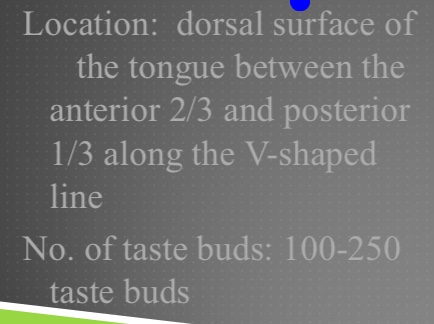
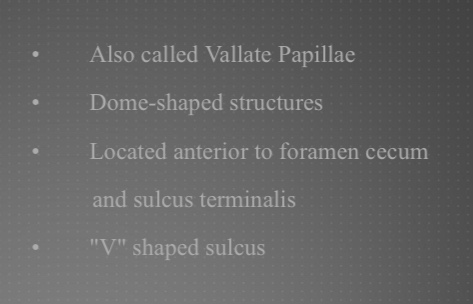
Circumvallate papillae (CV)
9
Circumvallate papillae (CV)
10
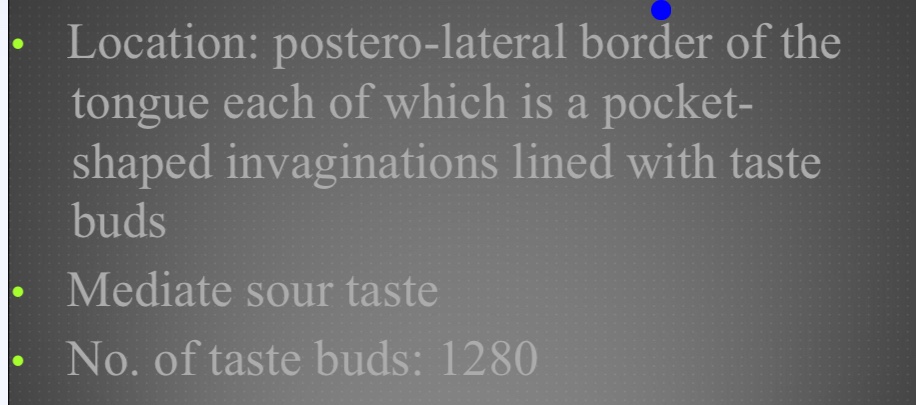
Foliate Papilla
11
Foliate Papilla
12
Fungiform Papillae
13
Fungiform Papillae
14
Filiform papilla
15
Filiform Papillae
16
provides fibers to the anterior two-thirds of the tongueFacial Nerve (Cranial Nerve VII)
17
provides fibers to the posterior third of the tongueGlossopharyngeal nerve (cranial nerve IX)
18
provides fibers to the epiglottis regionVagus nerve (cranial nerve X)
19
dominant taste of food containing L-glutamate -Also called savoryUmami
20
meat broth aged cheese ripe tomatoes asparagusUmami
21
Most common taste disorderPHANTOM TASTE PERCEPTION
22
A person with this disorder will have a strong, lingering taste in their mouth, even when it is empty. The taste is often unpleasant and may overpower the taste of other foods while they eat. The taste may also occur alongside a persistent burning sensation in the person’s mouth.PHANTOM TASTE PERCEPTION
23
Complete loss of tasteaguesia
24
Altered taste sensationDYSGEUSIA
25
Reduced or diminished sense of tasteHYPOGEUSIA
26
rare and only occurs in one to two people out of every 1,000.Complete loss of sense of taste/True Ageusia
27
Inability to distinguish between the various tastes A decreased desire to eat. Malnutrition Unintended weight lossAguesia
28
Altered sense of taste Describe all foods as tasting sweet, sour, bitter or metallic.Dysguesia
29
Foods that used to taste good now taste bad, and sometimes rotten. Foods that are characteristically sweet or salty no longer taste sweet or salty. All foods taste metallic or bitter. There’s a taste in your mouth even though you haven’t eaten anything.Dysguesia
30
Reduction in the ability to taste sweet, sour, bitter, salty, and umami. Results from conditions that affect the tongue. Usually caused by very dry mouthHypoguesia
31
unpleasant tasteparageusia