Question
7 components health history
Question
demographics, ie. age, gender, occupation, etc.
Question
usually the patient, but can be a family member or friend, letter of referral, or the medical record
Question
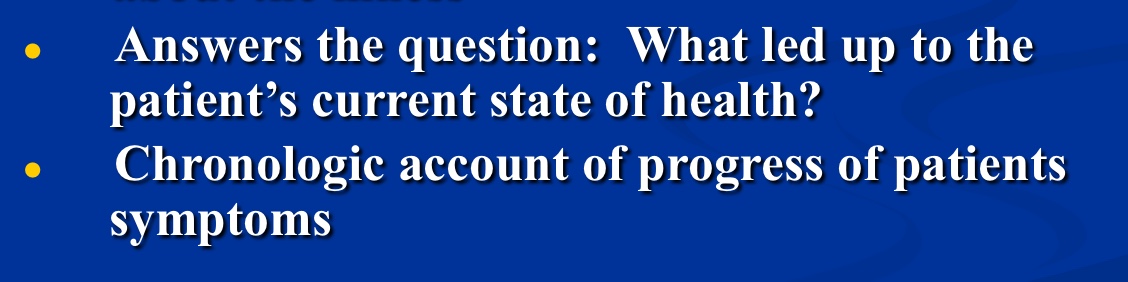
5 narratives history of present illness
Question
5 Past Medical History
Physical exam history taking ppt
 TestMaker
Score
0 / 10
Correct rate
0%
Correct: 0
Incorrect: 0
Unanswered: 10
Sporeformers

Sporeformers
Tameyra Stefani Al-Suhairy · 44 questions · 2 y agoSporeformers
Sporeformers
44 questions • 2 y agoSpirochetes
Spirochetes
Tameyra Stefani Al-Suhairy · 46 questions · 2 y agoSpirochetes
Spirochetes
46 questions • 2 y agoSubcutaneous, Systemic, Opportunistic Mycoses
Subcutaneous, Systemic, Opportunistic Mycoses
Tameyra Stefani Al-Suhairy · 75 questions · 2 y agoSubcutaneous, Systemic, Opportunistic Mycoses
Subcutaneous, Systemic, Opportunistic Mycoses
75 questions • 2 y agoMycobacteria
Mycobacteria
Tameyra Stefani Al-Suhairy · 46 questions · 2 y agoMycobacteria
Mycobacteria
46 questions • 2 y agoBacterial Classification, morphology, utrastructure
Bacterial Classification, morphology, utrastructure
Tameyra Stefani Al-Suhairy · 64 questions · 2 y agoBacterial Classification, morphology, utrastructure
Bacterial Classification, morphology, utrastructure
64 questions • 2 y agoHIV
HIV
Tameyra Stefani Al-Suhairy · 31 questions · 2 y agoHIV
HIV
31 questions • 2 y agoCORONA
CORONA
Tameyra Stefani Al-Suhairy · 24 questions · 2 y agoCORONA
CORONA
24 questions • 2 y agoPAPILLO
PAPILLO
Tameyra Stefani Al-Suhairy · 15 questions · 2 y agoPAPILLO
PAPILLO
15 questions • 2 y agoADENO
ADENO
Tameyra Stefani Al-Suhairy · 16 questions · 2 y agoADENO
ADENO
16 questions • 2 y agoPOX
POX
Tameyra Stefani Al-Suhairy · 6 questions · 2 y agoPOX
POX
6 questions • 2 y agoPARVO
PARVO
Tameyra Stefani Al-Suhairy · 25 questions · 2 y agoPARVO
PARVO
25 questions • 2 y agoHEPATOTROPHIC
HEPATOTROPHIC
Tameyra Stefani Al-Suhairy · 24 questions · 2 y agoHEPATOTROPHIC
HEPATOTROPHIC
24 questions • 2 y agoPICORNA
PICORNA
Tameyra Stefani Al-Suhairy · 25 questions · 2 y agoPICORNA
PICORNA
25 questions • 2 y agoRABIES
RABIES
Tameyra Stefani Al-Suhairy · 26 questions · 2 y agoRABIES
RABIES
26 questions • 2 y agoPARAMYXO
PARAMYXO
Tameyra Stefani Al-Suhairy · 20 questions · 2 y agoPARAMYXO
PARAMYXO
20 questions • 2 y agoHERPES
HERPES
Tameyra Stefani Al-Suhairy · 40 questions · 2 y agoHERPES
HERPES
40 questions • 2 y agoORTHO
ORTHO
Tameyra Stefani Al-Suhairy · 7 questions · 2 y agoORTHO
ORTHO
7 questions • 2 y agoFLAVI
FLAVI
Tameyra Stefani Al-Suhairy · 24 questions · 2 y agoFLAVI
FLAVI
24 questions • 2 y agoTOGA
TOGA
Tameyra Stefani Al-Suhairy · 19 questions · 2 y agoTOGA
TOGA
19 questions • 2 y agoVIRUS STRUCTURE
VIRUS STRUCTURE
Tameyra Stefani Al-Suhairy · 16 questions · 2 y agoVIRUS STRUCTURE
VIRUS STRUCTURE
16 questions • 2 y agoNormal Flora
Normal Flora
Tameyra Stefani Al-Suhairy · 61 questions · 2 y agoNormal Flora
Normal Flora
61 questions • 2 y agoBacterial physiology, growth, nutrition
Bacterial physiology, growth, nutrition
Tameyra Stefani Al-Suhairy · 63 questions · 2 y agoBacterial physiology, growth, nutrition
Bacterial physiology, growth, nutrition
63 questions • 2 y agoNeisseria & Corynebacterium
Neisseria & Corynebacterium
Tameyra Stefani Al-Suhairy · 27 questions · 2 y agoNeisseria & Corynebacterium
Neisseria & Corynebacterium
27 questions • 2 y agoMycology, superficial,cutaneous mycoses
Mycology, superficial,cutaneous mycoses
Tameyra Stefani Al-Suhairy · 31 questions · 2 y agoMycology, superficial,cutaneous mycoses
Mycology, superficial,cutaneous mycoses
31 questions • 2 y agoParasitology (Protozoa, Cestodes, Nematodes, Trematodes)
Parasitology (Protozoa, Cestodes, Nematodes, Trematodes)
Tameyra Stefani Al-Suhairy · 10 questions · 2 y agoParasitology (Protozoa, Cestodes, Nematodes, Trematodes)
Parasitology (Protozoa, Cestodes, Nematodes, Trematodes)
10 questions • 2 y agoEnterobacteriaceae
Enterobacteriaceae
Tameyra Stefani Al-Suhairy · 39 questions · 2 y agoEnterobacteriaceae
Enterobacteriaceae
39 questions • 2 y agoChlamydia
Chlamydia
Tameyra Stefani Al-Suhairy · 10 questions · 2 y agoChlamydia
Chlamydia
10 questions • 2 y agoStaphyloccocus and streptococcus
Staphyloccocus and streptococcus
Tameyra Stefani Al-Suhairy · 48 questions · 2 y agoStaphyloccocus and streptococcus
Staphyloccocus and streptococcus
48 questions • 2 y agoSterilization and disinfection
Sterilization and disinfection
Tameyra Stefani Al-Suhairy · 11 questions · 2 y agoSterilization and disinfection
Sterilization and disinfection
11 questions • 2 y agoBacteria and disease
Bacteria and disease
Tameyra Stefani Al-Suhairy · 52 questions · 2 y agoBacteria and disease
Bacteria and disease
52 questions • 2 y agoComplement hypersensitivity reactions, immunology, humoral and cell mediated immunity
Complement hypersensitivity reactions, immunology, humoral and cell mediated immunity
Tameyra Stefani Al-Suhairy · 99 questions · 2 y agoComplement hypersensitivity reactions, immunology, humoral and cell mediated immunity
Complement hypersensitivity reactions, immunology, humoral and cell mediated immunity
99 questions • 2 y agoNematodes
Nematodes
Tameyra Stefani Al-Suhairy · 25 questions · 2 y agoNematodes
Nematodes
25 questions • 2 y agoTrematodes
Trematodes
Tameyra Stefani Al-Suhairy · 23 questions · 2 y agoTrematodes
Trematodes
23 questions • 2 y agoCestodes
Cestodes
Tameyra Stefani Al-Suhairy · 11 questions · 2 y agoCestodes
Cestodes
11 questions • 2 y agoProtozoa
Protozoa
Tameyra Stefani Al-Suhairy · 12 questions · 2 y agoProtozoa
Protozoa
12 questions • 2 y agoCell injury, cell death, and adaptations
Cell injury, cell death, and adaptations
Tameyra Stefani Al-Suhairy · 62 questions · 2 y agoCell injury, cell death, and adaptations
Cell injury, cell death, and adaptations
62 questions • 2 y agoGENERAL PRINCIPLES
GENERAL PRINCIPLES
Tameyra Stefani Al-Suhairy · 72 questions · 2 y agoGENERAL PRINCIPLES
GENERAL PRINCIPLES
72 questions • 2 y agoGeneral Principles
General Principles
Tameyra Stefani Al-Suhairy · 43 questions · 2 y agoGeneral Principles
General Principles
43 questions • 2 y agoINTRODUCTION
INTRODUCTION
Tameyra Stefani Al-Suhairy · 64 questions · 2 y agoINTRODUCTION
INTRODUCTION
64 questions • 2 y agoRX WRITING
RX WRITING
Tameyra Stefani Al-Suhairy · 33 questions · 2 y agoRX WRITING
RX WRITING
33 questions • 2 y agoGYPSUM PRODUCTS
GYPSUM PRODUCTS
Tameyra Stefani Al-Suhairy · 30 questions · 2 y agoGYPSUM PRODUCTS
GYPSUM PRODUCTS
30 questions • 2 y agoQUIZ CC 1
QUIZ CC 1
Tameyra Stefani Al-Suhairy · 10 questions · 2 y agoQUIZ CC 1
QUIZ CC 1
10 questions • 2 y agoQuiz anesthesia
Quiz anesthesia
Tameyra Stefani Al-Suhairy · 10 questions · 2 y agoQuiz anesthesia
Quiz anesthesia
10 questions • 2 y agoGenetic Disorders
Genetic Disorders
Tameyra Stefani Al-Suhairy · 37 questions · 2 y agoGenetic Disorders
Genetic Disorders
37 questions • 2 y agoQuiz CNS
Quiz CNS
Tameyra Stefani Al-Suhairy · 20 questions · 2 y agoQuiz CNS
Quiz CNS
20 questions • 2 y agoQuiz ANS
Quiz ANS
Tameyra Stefani Al-Suhairy · 20 questions · 2 y agoQuiz ANS
Quiz ANS
20 questions • 2 y agoQuiz General principles
Quiz General principles
Tameyra Stefani Al-Suhairy · 20 questions · 2 y agoQuiz General principles
Quiz General principles
20 questions • 2 y agoQuiz Rx writing and math calculations
Quiz Rx writing and math calculations
Tameyra Stefani Al-Suhairy · 10 questions · 2 y agoQuiz Rx writing and math calculations
Quiz Rx writing and math calculations
10 questions • 2 y agoINTRO
INTRO
Tameyra Stefani Al-Suhairy · 10 questions · 2 y agoINTRO
INTRO
10 questions • 2 y agoQuiz routes of administration
Quiz routes of administration
Tameyra Stefani Al-Suhairy · 10 questions · 2 y agoQuiz routes of administration
Quiz routes of administration
10 questions • 2 y agoHEMODYNAMICS, COAGULATION CASCADES, THROMBOSIS SHOCK PATHOLOGY
HEMODYNAMICS, COAGULATION CASCADES, THROMBOSIS SHOCK PATHOLOGY
Tameyra Stefani Al-Suhairy · 12 questions · 2 y agoHEMODYNAMICS, COAGULATION CASCADES, THROMBOSIS SHOCK PATHOLOGY
HEMODYNAMICS, COAGULATION CASCADES, THROMBOSIS SHOCK PATHOLOGY
12 questions • 2 y agoQUIZ CC 2
QUIZ CC 2
Tameyra Stefani Al-Suhairy · 10 questions · 2 y agoQUIZ CC 2
QUIZ CC 2
10 questions • 2 y agoQuiz anesthesia LECTURE
Quiz anesthesia LECTURE
Tameyra Stefani Al-Suhairy · 20 questions · 2 y agoQuiz anesthesia LECTURE
Quiz anesthesia LECTURE
20 questions • 2 y agoImpression materials
Impression materials
Tameyra Stefani Al-Suhairy · 78 questions · 2 y agoImpression materials
Impression materials
78 questions • 2 y agoANESTHESIA
ANESTHESIA
Tameyra Stefani Al-Suhairy · 66 questions · 2 y agoANESTHESIA
ANESTHESIA
66 questions • 2 y agoQUIZ cell injury cell death and adaptations
QUIZ cell injury cell death and adaptations
Tameyra Stefani Al-Suhairy · 8 questions · 2 y agoQUIZ cell injury cell death and adaptations
QUIZ cell injury cell death and adaptations
8 questions • 2 y agoQUIZ genetic disorders
QUIZ genetic disorders
Tameyra Stefani Al-Suhairy · 10 questions · 2 y agoQUIZ genetic disorders
QUIZ genetic disorders
10 questions • 2 y agoQUIZ HEMODYNAMICS, COAGULATION CASCADES, THROMBOSIS SHOCK PATHOLOGY
QUIZ HEMODYNAMICS, COAGULATION CASCADES, THROMBOSIS SHOCK PATHOLOGY
Tameyra Stefani Al-Suhairy · 10 questions · 2 y agoQUIZ HEMODYNAMICS, COAGULATION CASCADES, THROMBOSIS SHOCK PATHOLOGY
QUIZ HEMODYNAMICS, COAGULATION CASCADES, THROMBOSIS SHOCK PATHOLOGY
10 questions • 2 y agoEnamel
Enamel
Tameyra Stefani Al-Suhairy · 100 questions · 2 y agoEnamel
Enamel
100 questions • 2 y agoEnamel PART 2
Enamel PART 2
Tameyra Stefani Al-Suhairy · 9 questions · 2 y agoEnamel PART 2
Enamel PART 2
9 questions • 2 y agoDentin
Dentin
Tameyra Stefani Al-Suhairy · 78 questions · 2 y agoDentin
Dentin
78 questions • 2 y agoQUIZ Dentin Pulp
QUIZ Dentin Pulp
Tameyra Stefani Al-Suhairy · 10 questions · 2 y agoQUIZ Dentin Pulp
QUIZ Dentin Pulp
10 questions • 2 y agoPulp
Pulp
Tameyra Stefani Al-Suhairy · 70 questions · 2 y agoPulp
Pulp
70 questions • 2 y agoSaliva and salivary glands
Saliva and salivary glands
Tameyra Stefani Al-Suhairy · 76 questions · 2 y agoSaliva and salivary glands
Saliva and salivary glands
76 questions • 2 y agoINTRO PPT
INTRO PPT
Tameyra Stefani Al-Suhairy · 77 questions · 2 y agoINTRO PPT
INTRO PPT
77 questions • 2 y agoPulp PART 2
Pulp PART 2
Tameyra Stefani Al-Suhairy · 36 questions · 2 y agoPulp PART 2
Pulp PART 2
36 questions • 2 y agoINTRO
INTRO
Tameyra Stefani Al-Suhairy · 11 questions · 2 y agoINTRO
INTRO
11 questions • 2 y agoPERIODONTIUM
PERIODONTIUM
Tameyra Stefani Al-Suhairy · 100 questions · 2 y agoPERIODONTIUM
PERIODONTIUM
100 questions • 2 y agoPERIODONTIUM PART 2
PERIODONTIUM PART 2
Tameyra Stefani Al-Suhairy · 67 questions · 2 y agoPERIODONTIUM PART 2
PERIODONTIUM PART 2
67 questions • 2 y agoQuiz pulp
Quiz pulp
Tameyra Stefani Al-Suhairy · 12 questions · 2 y agoQuiz pulp
Quiz pulp
12 questions • 2 y agoSALIVA
SALIVA
Tameyra Stefani Al-Suhairy · 17 questions · 2 y agoSALIVA
SALIVA
17 questions • 2 y agoInflammation and repair LECTURE
Inflammation and repair LECTURE
Tameyra Stefani Al-Suhairy · 35 questions · 2 y agoInflammation and repair LECTURE
Inflammation and repair LECTURE
35 questions • 2 y agoInflammation and repair part 2
Inflammation and repair part 2
Tameyra Stefani Al-Suhairy · 12 questions · 2 y agoInflammation and repair part 2
Inflammation and repair part 2
12 questions • 2 y agoWEEK 1 IC
WEEK 1 IC
Tameyra Stefani Al-Suhairy · 49 questions · 2 y agoWEEK 1 IC
WEEK 1 IC
49 questions • 2 y agoWEEK 2 HEPA
WEEK 2 HEPA
Tameyra Stefani Al-Suhairy · 34 questions · 2 y agoWEEK 2 HEPA
WEEK 2 HEPA
34 questions • 2 y agoWEEK 3 HIV
WEEK 3 HIV
Tameyra Stefani Al-Suhairy · 27 questions · 2 y agoWEEK 3 HIV
WEEK 3 HIV
27 questions • 2 y agoWEEK 4 TB
WEEK 4 TB
Tameyra Stefani Al-Suhairy · 30 questions · 2 y agoWEEK 4 TB
WEEK 4 TB
30 questions • 2 y agoinfectious disease
infectious disease
Tameyra Stefani Al-Suhairy · 10 questions · 2 y agoinfectious disease
infectious disease
10 questions • 2 y agoanti tb week 1
anti tb week 1
Tameyra Stefani Al-Suhairy · 57 questions · 2 y agoanti tb week 1
anti tb week 1
57 questions • 2 y agoElastomeric (Rubber) Impression Materials
Elastomeric (Rubber) Impression Materials
Tameyra Stefani Al-Suhairy · 67 questions · 2 y agoElastomeric (Rubber) Impression Materials
Elastomeric (Rubber) Impression Materials
67 questions • 2 y agoantiseptics and disinfectants
antiseptics and disinfectants
Tameyra Stefani Al-Suhairy · 45 questions · 2 y agoantiseptics and disinfectants
antiseptics and disinfectants
45 questions • 2 y agoPain
Pain
Tameyra Stefani Al-Suhairy · 71 questions · 2 y agoPain
Pain
71 questions • 2 y agoOlfaction
Olfaction
Tameyra Stefani Al-Suhairy · 46 questions · 2 y agoOlfaction
Olfaction
46 questions • 2 y agoTaste
Taste
Tameyra Stefani Al-Suhairy · 31 questions · 2 y agoTaste
Taste
31 questions • 2 y agoMastication and deglutition
Mastication and deglutition
Tameyra Stefani Al-Suhairy · 19 questions · 2 y agoMastication and deglutition
Mastication and deglutition
19 questions • 2 y agoTactile sensation
Tactile sensation
Tameyra Stefani Al-Suhairy · 32 questions · 2 y agoTactile sensation
Tactile sensation
32 questions • 2 y agoRespiratory
Respiratory
Tameyra Stefani Al-Suhairy · 61 questions · 2 y agoRespiratory
Respiratory
61 questions • 2 y agoSusceptible host
Susceptible host
Tameyra Stefani Al-Suhairy · 73 questions · 2 y agoSusceptible host
Susceptible host
73 questions • 2 y agoBiofilm
Biofilm
Tameyra Stefani Al-Suhairy · 46 questions · 2 y agoBiofilm
Biofilm
46 questions • 2 y agoDental caries
Dental caries
Tameyra Stefani Al-Suhairy · 67 questions · 2 y agoDental caries
Dental caries
67 questions • 2 y agoSubstrate
Substrate
Tameyra Stefani Al-Suhairy · 36 questions · 2 y agoSubstrate
Substrate
36 questions • 2 y agoinfectious disease lec
infectious disease lec
Tameyra Stefani Al-Suhairy · 48 questions · 2 y agoinfectious disease lec
infectious disease lec
48 questions • 2 y agoQuestion list
1
Subjective data
2
Objective data
3
7 components health historyIdentifying Data and Source of the History, Chief Complaint, History of Present Illness, Past Medical History, Family History, Personal and Social History, Review of Systems
4
demographics, ie. age, gender, occupation, etc.Identifying Data
5
usually the patient, but can be a family member or friend, letter of referral, or the medical recordSource of History
6
Chief Complaint
7
History of Present Illness
8
History of Present Illness
9
5 narratives history of present illnessonset of the problem, setting in which it has developed, Manifestations, Treatments attempted, Answers question: Did anything make it better or worse?
10
5 Past Medical Historychildhood illnesses, adult illnesses and surgeries with dates, health maintenance practices such as immunizations, screening tests, lifestyle issues, and home safety, Hospitalizations, Psychiatric illnesses and time frame, diagnoses, hospitalizations, and treatment
11
8 screening testsTuberculin skin tests, Pap smears, Mammograms, Stool tests for occult blood, Cholesterol tests, Sickle cell tests, HIV tests, Hepatitis A, B, C
12
Family History
13
Personal and Social History
14
Personal and Social History
15
Personal and Social History
16
Personal and Social History
17
Review of Systems
18
Review of Systems
19
number 1 Sequence of Clinical ExaminationGeneral appraisal (including temperature, pulse rate, and blood pressure
20
number 9 and last Sequence of Clinical ExaminationOcclusion
21
Temperature elevationHyperthermia
22
Temperature depressionhypothermia
23
systolic pressure
24
Resting blood pressureDiastolic
25
anthropometric longitudinal growth of an individualHeight
26
device used to measure height although often a height stick is more frequently used for vertical measurement of adults or children older than 2.Statiometer
27
Height declines during the day because of compression of theIntervertebral discs
28
used to calculate the relationship between healthy height and weight and obesity or being overweight or underweight.BMI
29
Use of the diaphragm and bell of the stethoscope to detect the characteristics of heart, lung, and bowel sounds, including location, timing, duration, pitch, and intensityAuscultation
30
method used by a doctor to find out about the changes in the thorax or abdomen. tapping on a surface to determine the underlying structure.Percussion
31
method of examination in which the examiner feels the size or shape or firmness or location of something.Palpation
32
used by doctors particularly for thoracic and abdominal examinations, but also for examination of edema and palpation of pulses.Palpation
33
Listening to any sounds emanating from the patient ●Odors that may be presentInspection
34
6 gross deviationabnormal contour, scars and striae, visible masses, discoloration, swelling, tremor
35
thorough and unhurried visualization of the client. This requires the use of the naked eye.Inspection
36
4Methods of Clinical ExaminationInspection-Visual Inspection, Palpation, Percussion, Auscultation
37
6 endocrineThyroid conditions, Heat or cold intolerance, Excessive sweating, Excessive thirst or hunger, Polyuria, Change in glove or shoe size
38
4 HematologicAnemia, Easy bruising or bleeding, Past transfusions, Transfusion reactions
39
6 PsychiatricNervousness, Tension, Mood, Including depression, Memory change, Suicide attempts
40
7 MusculoskeletalMuscle or joint pain, Stiffness, Arthritis, Gout, Backache, Neck or low back pain, Joint pain with systemic features such as fever, chills, rash, anorexia, weight loss, or weakness
41
7 Peripheral VascularIntermittent claudication, Leg cramps, Varicose veins, Deep vein thrombosis, Swelling in calves, legs, or feet, Color change in fingertips or toes during cold weather, Swelling with redness or tenderness
42
4 breastLumps, Pain, Nipple discharge, Self-Examination practices
43
5 neckSwollen glands, Goiter, Lumps, Pain, Stiffness
44
8Throat (Mouth and Pharynx)Condition of teeth and gums, Bleeding gums, Dentures, Sore tongue, Last dental examination, Dry mouth, Frequent sore throats, Hoarseness
45
7Nose and SinusesFrequent colds, Nasal stuffiness, Discharge, Itching, Hay fever, Nosebleeds, Sinus Infections
46
Ears 4Tinnitus, Vertigo, Infection, Discharge
47
Head 5Dizziness, Syncope, Vertigo, Lumps, Sores
48
eyes 4Glaucoma, Itching, Specks, Spots
49
Respiratory 7Sputum, Hemoptysis, Dyspnea, Wheezing, Pleurisy, Chest X-Ray, Cough
50
10 CardiovascularRheumatic fever, Dyspnea, Orthopnea, Edema, Palpitations, Chest pain, Hypertension, Paroxysmal nocturnal dyspnea, Electrocardiograms, Echocardiograms
51
6 urinaryPolyuria, Kidney stones, Suprapubic pain, Incontinence, Hesitancy, Dribbling
52
genital 4 maleHernias, sexually transmitted diseases, HIV infection or exposure, Sexual habit,
53
9 neurologicSyncope, Seizures, Weakness, Paralysis, Tingling or “pins and needles”, Tremors or involuntary seizures, Vertigo, Syncope, Numbness or loss of sensation
54
HemoptysisRespiratory
55
SputumRespiratory
56
PleurisyRespiratory
57
Dyspnea OrthopneaCardiovascular
58
Edema • Electrocardiograms • EchocardiogramsCardiovascular
59
PalpitationsCardiovascular
60
Hypertension Rheumatic feverCardiovascular