​
Sign in

PHYSICS

41 questions • 2024-07-30
40
  • Jasmine Achicoso
  • Report

    Question

    Which of the following is not a fundamental physical quantity?

    • velocity

    • time

    • length

    • mass

    • Skip

    Question

    A quantity having both magnitude and direction is called a vector quantity. Which below can be represented by a vector quantity?

    • distance

    • temperature

    • displacement

    • volume

    • Skip

    Question

    Two forces, one 40 Newton, the other 26 Newton act on a body. The directions of the forces are unknown. What is the minimum possible magnitude of the resultant vector

    • - 26 N

    • 66 N

    • 14 N

    • -40 N

    • Skip

    Question

    In the previous problem, what is the maximum possible magnitude of the resultant vector?

    • 14 N

    • 26 N

    • 40 N

    • 66 N

    • Skip

    Question

    What is the resultant of this system?
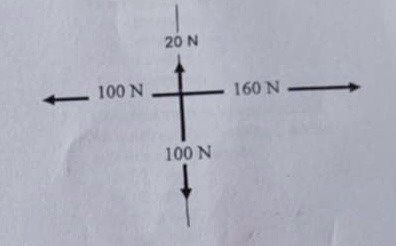
    • 100 N located on the 4th quadrant

    • 100 N located on the 1st quadrant

    • 120 N 315 from the + x axis

    • 120 N 225 degrees from the + x axis

    • Skip

    Question

    After reaching the finish line 100 m. from the starting line, runner A moves 5 m. beyond the finish line and then goes back to meet runner B. When they meet, runner B is still 10 m. away from the finish line. What is the net displacement of runner A?

    • 10 m. to the right of the finish line

    • 10 m. to the right of the starting line

    • 90 m. to the right of the starting line

    • 90 m. to the right of the finish line

    • Skip

    Question

    A can of biscuit is usually opened with a spoon. When used this way the spoon is an example of a lever. Which statement best describes the positions of the effort, fulcrum and resistance?

    • The resistance is between the fulcrum and effort.

    • The fulcrum is between the resistance and effort.

    • The effort is between the fulcrum and resistance.

    • The resistance and fulcrum are the same point.

    • Skip

    Question

    The efficiency of a machine is:

    • always greater than 100%

    • always less than 100%

    • more or less than 100%

    • equal too 100%

    • Skip

    Question

    When an object moves at constant velocity, the net force acting on it is

    • zero

    • greater than its mass

    • smaller than its mass

    • equal to its mass

    • Skip

    Question

    The tendency of a body to remain at rest or in motion unless acted upon by an external unbalanced force:

    • inertia

    • momentum

    • acceleration

    • interaction

    • Skip

    PHYSICS

    TestMaker

    Score

    0 / 10

    Correct rate

    0%

    Correct: 0

    Incorrect: 0

    Unanswered: 10

     
    ankimaker.com

    GENERAL SCIENCE

    GENERAL SCIENCE

    Jasmine Achicoso · 85 questions · 2 y ago

    GENERAL SCIENCE

    GENERAL SCIENCE

    85 questions • 2 y ago
    Jasmine Achicoso

    Lesson 2: CONTRIBUTION ON CELL THEORY

    Lesson 2: CONTRIBUTION ON CELL THEORY

    Jasmine Achicoso · 9 questions · 2 y ago

    Lesson 2: CONTRIBUTION ON CELL THEORY

    Lesson 2: CONTRIBUTION ON CELL THEORY

    9 questions • 2 y ago
    Jasmine Achicoso

    science

    science

    Jasmine Achicoso · 16 questions · 2 y ago

    science

    science

    16 questions • 2 y ago
    Jasmine Achicoso

    Lesson 3: Function and Parts of PLANT AND ANIMAL CELLS

    Lesson 3: Function and Parts of PLANT AND ANIMAL CELLS

    Jasmine Achicoso · 9 questions · 2 y ago

    Lesson 3: Function and Parts of PLANT AND ANIMAL CELLS

    Lesson 3: Function and Parts of PLANT AND ANIMAL CELLS

    9 questions • 2 y ago
    Jasmine Achicoso

    Lesson 6: CELL CYCLE

    Lesson 6: CELL CYCLE

    Jasmine Achicoso · 21 questions · 2 y ago

    Lesson 6: CELL CYCLE

    Lesson 6: CELL CYCLE

    21 questions • 2 y ago
    Jasmine Achicoso

    Lesson 5: Cell Types

    Lesson 5: Cell Types

    Jasmine Achicoso · 5 questions · 2 y ago

    Lesson 5: Cell Types

    Lesson 5: Cell Types

    5 questions • 2 y ago
    Jasmine Achicoso

    Question list

  • 1

    Which of the following is not a fundamental physical quantity?

    velocity

  • 2

    A quantity having both magnitude and direction is called a vector quantity. Which below can be represented by a vector quantity?

    displacement

  • 3

    Two forces, one 40 Newton, the other 26 Newton act on a body. The directions of the forces are unknown. What is the minimum possible magnitude of the resultant vector

    14 N

  • 4

    In the previous problem, what is the maximum possible magnitude of the resultant vector?

    14 N

  • 5

    What is the resultant of this system?

    100 N located on the 4th quadrant

  • 6

    After reaching the finish line 100 m. from the starting line, runner A moves 5 m. beyond the finish line and then goes back to meet runner B. When they meet, runner B is still 10 m. away from the finish line. What is the net displacement of runner A?

    90 m. to the right of the starting line

  • 7

    A can of biscuit is usually opened with a spoon. When used this way the spoon is an example of a lever. Which statement best describes the positions of the effort, fulcrum and resistance?

    The fulcrum is between the resistance and effort.

  • 8

    The efficiency of a machine is:

    always less than 100%

  • 9

    When an object moves at constant velocity, the net force acting on it is

    zero

  • 10

    The tendency of a body to remain at rest or in motion unless acted upon by an external unbalanced force:

    inertia

  • 11

    When an object falls freely, its acceleration is:

    constant

  • 12

    Calculate the rate of acceleration for a runner who reaches a speed of 2 m/s in 10 seconds. a. C. d.

    0.2 m/s^2

  • 13

    For a ball thrown vertically upward, the time it takes to reach its maximum height is_the time it takes to go down.

    equal to

  • 14

    When a stone is thrown up into the air, at what point in its flight is the velocity decreasing?

    before it reaches the highest point

  • 15

    What can you say about the motion of a stone thrown vertically upwards? a. b. C. d.

    The stone increases speed as it falls from maximum height at constant acceleration.

  • 16

    When will the ball reach a speed of 49 m/s?

    after 5s and 15 s

  • 17

    What is the maximum height that the ball will reach?

    490 m

  • 18

    Which of the following is true?

    The potential energy for I is greater than the kinetic energy for ll.

  • 19

    Which of the following is not true about a projectile fired at 196 m/s at an angle of 30 degrees with the horizontal? All of the

    It has zero acceleration when it reaches maximum height.

  • 20

    Which of the following is not true about a projectile fired at 196 m/s at an angle of 30 degrees with the horizontal?

    Velocity decreases to zero when it reaches maximum height then increases further on.

  • 21

    According to the Law of Conservation of Momentum, the total momentum of a system before a collision is the total momentum of the system after collision.

    equal to

  • 22

    A bullet of mass 0.01 kg is fired into suspended wooden block of mass 0.29 kg at 120 meters/second. If the bullet remains in the block after the collision, what is the final velocity of the bullet and block?

    4 m/s

  • 23

    Which of the following is not a unit of pressure?

    Joule

  • 24

    A lift of mass 1700 kg moves upwards with an acceleration of 1.5 m/s?. What is the upward force acting on the lift?

    2550 N

  • 25

    In the previous problem, what is the weight of the lift?

    16660 N

  • 26

    A 10 kg mass is held 1.0 m above a table for 25 seconds. How much work is done during that period?

    0 Joules

  • 27

    A horse exerts a force of 3,000 N while pulling a cart for 6 km. How much work does the horse do? Give your answer in mega joules

    18 MJ

  • 28

    A rocket coasting along in space at some speed, V, fires Its engines thus doubling its speed. At the same time, It unloads some cargo reducing its mass to half Its value. In the process, Its kinetic energy is a,

    doubled

  • 29

    In an activity, Joel observed that there are two sets of circular waves spreading out across the surface of the water in the tank. This shows:

    diffraction

  • 30

    The term used to describe the constant random motion of colloidal particles.

    Brownian movement

  • 31

    When a long, straight wooden pole is partly submerged in water, the pole looks bent. What explains this phenomenon?

    refraction

  • 32

    Which is true of sound waves?

    both a and b

  • 33

    A race car emits a distinctive roar when it passes you and slowly the frequency decreases as it moves away, it exhibits:

    Doppler effect

  • 34

    Which scientist would have most likely used phrases "equal areas", "planetary period", and "elliptic foci”?

    Johannes Kepler

  • 35

    To calculate the gravitational force between two objects, you do net need to know the:

    acceleration of both objects

  • 36

    The force of attraction between 2 identical bodies of 1 kg mass and separated distance of 1 meter.

    6.67 x 10^-11 newtons

  • 37

    The statements below comprises Keplers' Laws of Planetary Motion except for:

    The periods of the planet are proportional to 3/2 powers of the major axis lengths of their orbits

  • 38

    The first law of thermodynamics states that:

    While the kind of energy in a closed system can change, the total amount cannot.

  • 39

    A boy spins vertically a marble attached to a string. At which point is the tension greatest?

    at the lowest point

  • 40

    What has to happen for an object to maintain a circular path?

    the speed must be kept constant

  • 41

    Uniform circular motion involves:

    change in direction but not change in speed
