Question
1. Steam expands adiabatically in a turbine 2000 kPa, 400°C to 400 kPa, 250°C. What is the effectiveness of 15°C. Neglect changes in kinetic energy and potential energy.
Question
2. In a cogeneration plant, steam enters the turbine at 4 MPa and 400°C. One fourth of the steam is extracted from the turbine at 600 KPa pressure heating. The remaining steam continues to expand to 10 KPa. The extracted steam is then condensed and mixed with feedwater at constant pressure and the mixture is pumped to the boiler pressure of 4 MPa. The mass flow rate of the steam through the boiler is 30 kg/s. Disregarding any pressure drop and heat losses in the piping, and assuming the turbine and pump to be isentropic, how much processed heat is required in KW?
Question
3. A 23.5 kg steam per second at 5 MPa and 400°C is produced by a steam generator. The feedwater enters the economizer at 145°C and leaves at 205°C. The steam leaves the boiler drum with a quality of 98 %. The unit consumes 2.75 kg of coal per second as received having a heating value of 25102 KJ/kg. What would be the overall efficiency of the unit in percent?
Question
4. A Steam generating plant consisting of a boiler, an economizer and super heater generates superheated steam at the rate of 50 tons per hr. Feedwater enters the boiler at 5 MPa and 120°C. Steam leaves the supęrheater at 4.5 MPa and 320°C. If the coal used has a heating value of 30,000 KJ/kg. Calculate the no. of tons coal fired per hr for a gross efficiency of 85%.
Question
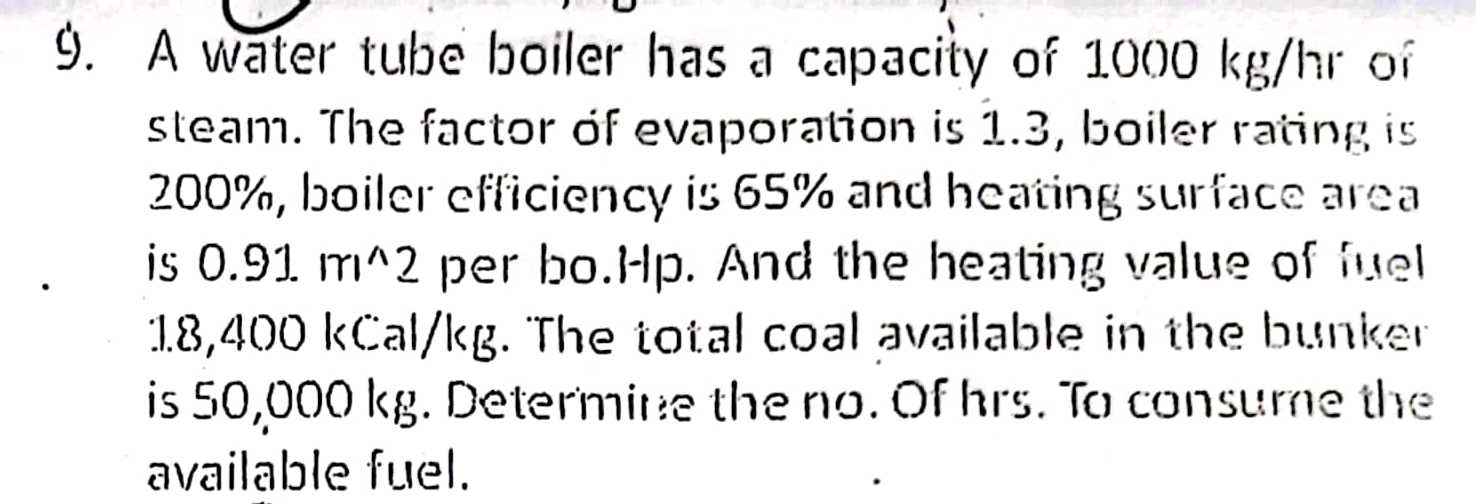
5. A water tube boiler has a capacity of 1000 kg/hr of steam, the factor of evaporation is 1.3, boiler rating is 200 %, boiler efficiency is 65%, heating surface area is 0.91 m^2 per bo. HP, and the heating value of fuel is 18400 kCal/kg. The total coal available in the bunker is 50000 kg. Determine the no. Of hours to consume the available fuel.
Question
6. Steam turbine is receiving 1014 Ibm/hr of steam, determine the horsepower output of the turbine if the work done by steam is 251 Btu/lbm.
Question
7. One kilogram of wet steam at a pressure of 3 bar ( Ug = 0.2404 m³/kg, Uf = 0.0011148 m³/kg and dryness of 0.94 is expanded until the pressure is 4 bar ( Ug = 0.4625 m³/kg, Uf = 0.0010836 m³/kg). If the expansion follows the law PV^n = C, where n = 1.12, find the dryness fraction of the steam at the lower pressure.
Question
Answer the following:
Question
Answer the following:
Question
Answer the following:
[ PPE ] [ QUIZ 1 ]
 TestMaker
Score
0 / 10
Correct rate
0%
Correct: 0
Incorrect: 0
Unanswered: 10
Machine Design ( 1st Set )

Machine Design ( 1st Set )
Jacky Shane Luyas Buhia · 20 questions · 3 y agoMachine Design ( 1st Set )
Machine Design ( 1st Set )
20 questions • 3 y agoTransformers Board Exam ( EE ) Reviewer
Transformers Board Exam ( EE ) Reviewer
Jacky Shane Luyas Buhia · 43 questions · 4 y agoTransformers Board Exam ( EE ) Reviewer
Transformers Board Exam ( EE ) Reviewer
43 questions • 4 y ago[ PPE ] [ QUIZ 2 ]
[ PPE ] [ QUIZ 2 ]
Jacky Shane Luyas Buhia · 11 questions · 3 y ago[ PPE ] [ QUIZ 2 ]
[ PPE ] [ QUIZ 2 ]
11 questions • 3 y agoTest 1~2
Test 1~2
Jacky Shane Luyas Buhia · 100 questions · 3 y agoTest 1~2
Test 1~2
100 questions • 3 y agoTest 2
Test 2
Jacky Shane Luyas Buhia · 99 questions · 3 y agoTest 2
Test 2
99 questions • 3 y agoBES MRB ( Elements 101 ) - 1.docx
BES MRB ( Elements 101 ) - 1.docx
Jacky Shane Luyas Buhia · 100 questions · 4 y agoBES MRB ( Elements 101 ) - 1.docx
BES MRB ( Elements 101 ) - 1.docx
100 questions • 4 y agoTransformers Board Exam ( EE ) Reviewer
Transformers Board Exam ( EE ) Reviewer
Jacky Shane Luyas Buhia · 79 questions · 4 y agoTransformers Board Exam ( EE ) Reviewer
Transformers Board Exam ( EE ) Reviewer
79 questions • 4 y agoProblem_Solving_01
Problem_Solving_01
Jacky Shane Luyas Buhia · 20 questions · 2 y agoProblem_Solving_01
Problem_Solving_01
20 questions • 2 y agoCompre_Quiz_4
Compre_Quiz_4
Jacky Shane Luyas Buhia · 19 questions · 2 y agoCompre_Quiz_4
Compre_Quiz_4
19 questions • 2 y agoReferences
References
Jacky Shane Luyas Buhia · 11 questions · 2 y agoReferences
References
11 questions • 2 y agoElements_01
Elements_01
Jacky Shane Luyas Buhia · 100 questions · 2 y agoElements_01
Elements_01
100 questions • 2 y agoElements_01
Elements_01
Jacky Shane Luyas Buhia · 50 questions · 2 y agoElements_01
Elements_01
50 questions • 2 y agoProblem_Solving_01
Problem_Solving_01
Jacky Shane Luyas Buhia · 15 questions · 2 y agoProblem_Solving_01
Problem_Solving_01
15 questions • 2 y agoElements_02
Elements_02
Jacky Shane Luyas Buhia · 50 questions · 2 y agoElements_02
Elements_02
50 questions • 2 y agoConversions_01
Conversions_01
Jacky Shane Luyas Buhia · 15 questions · 2 y agoConversions_01
Conversions_01
15 questions • 2 y agoProblem_Solving_02
Problem_Solving_02
Jacky Shane Luyas Buhia · 20 questions · 2 y agoProblem_Solving_02
Problem_Solving_02
20 questions • 2 y agoProblem_Solving_03
Problem_Solving_03
Jacky Shane Luyas Buhia · 11 questions · 2 y agoProblem_Solving_03
Problem_Solving_03
11 questions • 2 y agoProblem_Solving_02
Problem_Solving_02
Jacky Shane Luyas Buhia · 45 questions · 2 y agoProblem_Solving_02
Problem_Solving_02
45 questions • 2 y agoElements_01
Elements_01
Jacky Shane Luyas Buhia · 50 questions · 2 y agoElements_01
Elements_01
50 questions • 2 y agoElements_03
Elements_03
Jacky Shane Luyas Buhia · 50 questions · 2 y agoElements_03
Elements_03
50 questions • 2 y agoAIR CONDITIONING
AIR CONDITIONING
Jacky Shane Luyas Buhia · 100 questions · 2 y agoAIR CONDITIONING
AIR CONDITIONING
100 questions • 2 y agoFLUID MECHANICS 01
FLUID MECHANICS 01
Jacky Shane Luyas Buhia · 91 questions · 2 y agoFLUID MECHANICS 01
FLUID MECHANICS 01
91 questions • 2 y agoElements_05
Elements_05
Jacky Shane Luyas Buhia · 50 questions · 2 y agoElements_05
Elements_05
50 questions • 2 y agoPIPE 1_01
PIPE 1_01
Jacky Shane Luyas Buhia · 100 questions · 2 y agoPIPE 1_01
PIPE 1_01
100 questions • 2 y agoProblem_Solving_04
Problem_Solving_04
Jacky Shane Luyas Buhia · 20 questions · 2 y agoProblem_Solving_04
Problem_Solving_04
20 questions • 2 y agoPIPE 1_02
PIPE 1_02
Jacky Shane Luyas Buhia · 100 questions · 2 y agoPIPE 1_02
PIPE 1_02
100 questions • 2 y agoLTO_Drivers_Licensure_Exam_01
LTO_Drivers_Licensure_Exam_01
Jacky Shane Luyas Buhia · 100 questions · 2 y agoLTO_Drivers_Licensure_Exam_01
LTO_Drivers_Licensure_Exam_01
100 questions • 2 y agoLTO_Drivers_Licensure_Exam_02
LTO_Drivers_Licensure_Exam_02
Jacky Shane Luyas Buhia · 100 questions · 2 y agoLTO_Drivers_Licensure_Exam_02
LTO_Drivers_Licensure_Exam_02
100 questions • 2 y agoElements_06
Elements_06
Jacky Shane Luyas Buhia · 50 questions · 2 y agoElements_06
Elements_06
50 questions • 2 y agoENGINEERING ECONOMICS 01
ENGINEERING ECONOMICS 01
Jacky Shane Luyas Buhia · 11 views · 100 questions · 2 y agoENGINEERING ECONOMICS 01
ENGINEERING ECONOMICS 01
11 views • 100 questions • 2 y agoProblem_Solving_01
Problem_Solving_01
Jacky Shane Luyas Buhia · 20 questions · 2 y agoProblem_Solving_01
Problem_Solving_01
20 questions • 2 y agoProblem_Solving_02
Problem_Solving_02
Jacky Shane Luyas Buhia · 20 questions · 2 y agoProblem_Solving_02
Problem_Solving_02
20 questions • 2 y agoProblem_Solving_03
Problem_Solving_03
Jacky Shane Luyas Buhia · 30 questions · 2 y agoProblem_Solving_03
Problem_Solving_03
30 questions • 2 y agoProblem_Solving_04
Problem_Solving_04
Jacky Shane Luyas Buhia · 30 questions · 2 y agoProblem_Solving_04
Problem_Solving_04
30 questions • 2 y agoElements_02
Elements_02
Jacky Shane Luyas Buhia · 50 questions · 2 y agoElements_02
Elements_02
50 questions • 2 y agoProblem_Solving_03
Problem_Solving_03
Jacky Shane Luyas Buhia · 20 questions · 2 y agoProblem_Solving_03
Problem_Solving_03
20 questions • 2 y agoElements_03
Elements_03
Jacky Shane Luyas Buhia · 50 questions · 2 y agoElements_03
Elements_03
50 questions • 2 y agoProblem_Solving_05
Problem_Solving_05
Jacky Shane Luyas Buhia · 30 questions · 2 y agoProblem_Solving_05
Problem_Solving_05
30 questions • 2 y agoProblem_Solving_06
Problem_Solving_06
Jacky Shane Luyas Buhia · 30 questions · 1 y agoProblem_Solving_06
Problem_Solving_06
30 questions • 1 y agoProblem_Solving_04
Problem_Solving_04
Jacky Shane Luyas Buhia · 20 questions · 1 y agoProblem_Solving_04
Problem_Solving_04
20 questions • 1 y agoProblem_Solving_07
Problem_Solving_07
Jacky Shane Luyas Buhia · 30 questions · 1 y agoProblem_Solving_07
Problem_Solving_07
30 questions • 1 y agoProblem_Solving_05
Problem_Solving_05
Jacky Shane Luyas Buhia · 20 questions · 1 y agoProblem_Solving_05
Problem_Solving_05
20 questions • 1 y agoElements_04
Elements_04
Jacky Shane Luyas Buhia · 50 questions · 1 y agoElements_04
Elements_04
50 questions • 1 y agoLTO_Drivers_Licensure_Exam_03
LTO_Drivers_Licensure_Exam_03
Jacky Shane Luyas Buhia · 65 questions · 1 y agoLTO_Drivers_Licensure_Exam_03
LTO_Drivers_Licensure_Exam_03
65 questions • 1 y agoElements_05
Elements_05
Jacky Shane Luyas Buhia · 50 questions · 1 y agoElements_05
Elements_05
50 questions • 1 y agoElements_02
Elements_02
Jacky Shane Luyas Buhia · 100 questions · 1 y agoElements_02
Elements_02
100 questions • 1 y agoQuestion list
1
1. Steam expands adiabatically in a turbine 2000 kPa, 400°C to 400 kPa, 250°C. What is the effectiveness of 15°C. Neglect changes in kinetic energy and potential energy.a. 79
2
2. In a cogeneration plant, steam enters the turbine at 4 MPa and 400°C. One fourth of the steam is extracted from the turbine at 600 KPa pressure heating. The remaining steam continues to expand to 10 KPa. The extracted steam is then condensed and mixed with feedwater at constant pressure and the mixture is pumped to the boiler pressure of 4 MPa. The mass flow rate of the steam through the boiler is 30 kg/s. Disregarding any pressure drop and heat losses in the piping, and assuming the turbine and pump to be isentropic, how much processed heat is required in KW?d. 15647.5
3
3. A 23.5 kg steam per second at 5 MPa and 400°C is produced by a steam generator. The feedwater enters the economizer at 145°C and leaves at 205°C. The steam leaves the boiler drum with a quality of 98 %. The unit consumes 2.75 kg of coal per second as received having a heating value of 25102 KJ/kg. What would be the overall efficiency of the unit in percent?c. 88
4
4. A Steam generating plant consisting of a boiler, an economizer and super heater generates superheated steam at the rate of 50 tons per hr. Feedwater enters the boiler at 5 MPa and 120°C. Steam leaves the supęrheater at 4.5 MPa and 320°C. If the coal used has a heating value of 30,000 KJ/kg. Calculate the no. of tons coal fired per hr for a gross efficiency of 85%.b. 4.889 tons/hr
5
5. A water tube boiler has a capacity of 1000 kg/hr of steam, the factor of evaporation is 1.3, boiler rating is 200 %, boiler efficiency is 65%, heating surface area is 0.91 m^2 per bo. HP, and the heating value of fuel is 18400 kCal/kg. The total coal available in the bunker is 50000 kg. Determine the no. Of hours to consume the available fuel.d. 853.36 hrs
6
6. Steam turbine is receiving 1014 Ibm/hr of steam, determine the horsepower output of the turbine if the work done by steam is 251 Btu/lbm.a. 100 hp
7
7. One kilogram of wet steam at a pressure of 3 bar ( Ug = 0.2404 m³/kg, Uf = 0.0011148 m³/kg and dryness of 0.94 is expanded until the pressure is 4 bar ( Ug = 0.4625 m³/kg, Uf = 0.0010836 m³/kg). If the expansion follows the law PV^n = C, where n = 1.12, find the dryness fraction of the steam at the lower pressure.a. 0.9072
8
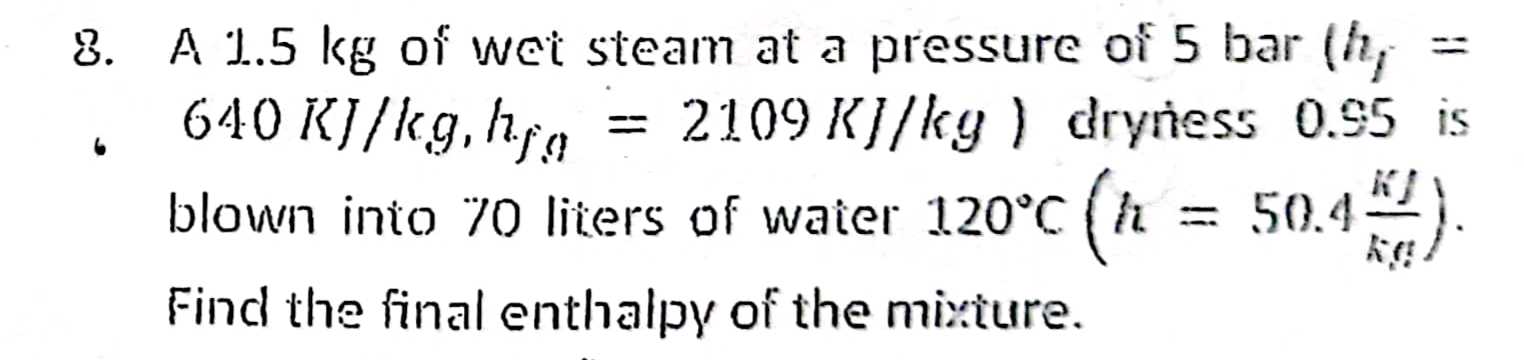
Answer the following:d. 104.80 KJ/kg
9
Answer the following:a. 853.36 hrs
10
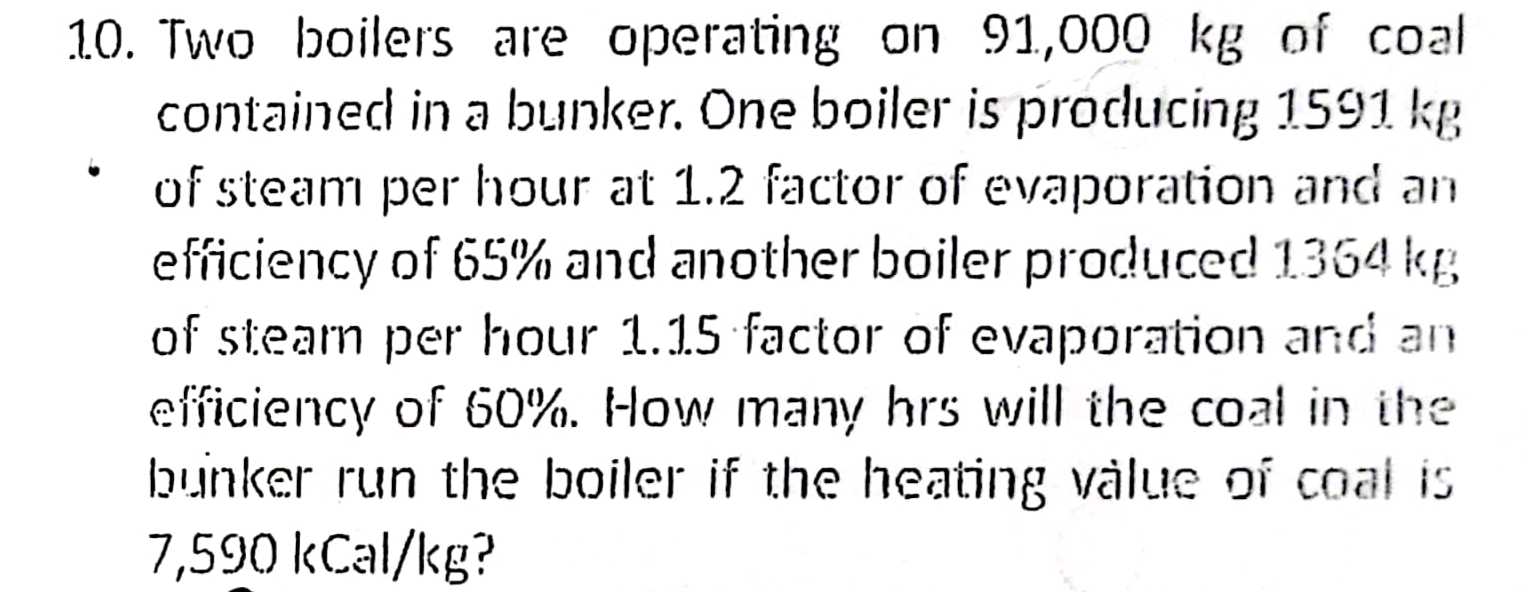
Answer the following:a. 230.80 hrs
11
Answer the following:c. air preheater
12
Answer the following:a. Engine indicator
13
Answer the following:d. Indicator diagram
14
14. The power output of the generatord. Electrical Power
15
15. The amount of fuel needed to perform a unit of powera. Specific fuel consumption
16
16. The ratio of heat converted to useful power to the heat supplied.c. Thermal efficiency
17
17. The ratio of the actual power of the engine to its ideal power.d. Engine efficiency
18
18. The ratio of the cylinder volumes after and before the combustion process.b. Cut-off ratio
19
19. The position of the piston when it forms the smallest volume in the cylinder.b. Head End Dead Center Position
20
20. The power developed in the engine cylinder as obtained from the pressure in the cylinder.c. Indicated power
21
21. The difference between the maximum and minimum volume.c. Clearance volume
22
22. What is the primary purpose of an Electric Power Substation ?c. To switch or transform voltage levels
23
23. What does the term " Load " refer to in the context of electric power ?c. The power delivered by a machine
24
24. Which curve represents the average of daily load curves over a one-month period and is used for rate establishment?c. Monthly Load Curve
25
25. What is the " Maximum Demand " often referred to as ?b. Peak Load
26
26. What is the purpose of a Load-Duration Curve ?b. To rearrange data from a chronological load curve
27
27. What does " Demand Factor " measure ?a. The ratio of connected load to maximum demand
28
28. What is the " Diversity Factor " in electrical systems ?c. The ratio of individual maximum demands to simultaneous maximum demand.
29
29. What is " Base Load " in the context of electrical systems ?b. The minimum load over a given period
30
30. What does a Load-Energy Curve indicate?a. The total energy for a given load and all values less (greater) than that load.
31
31. What is " Connected Load " defined as ?a. The sum of all connected equipment
32
32. What does the " Annual Load Curve " represent ?a. The maximum demand over a year
33
33. What does " Load Factor " measure ?a. The ratio of connected load to maximum demand
34
34. What is the " Coincidence Factor " ?b. The reciprocal of diversity factor
35
35. What is the " Plant Factor " ?b. The ratio of average load on the plant to the aggregate rating of all generating equipment.
36
36. What is the " Capacity Factor " defined as ?a. The ratio of average load on a machine to its rating
37
37. The maximum demand on a power station is 100 MW. If the annual load factor is 40%, calculate the total energy generated in a year.a. 3504 × 10⁵ kWh
38
38. A generating station has a connected load of 42 (43) and a maximum demand of 20 MW; the units generated being 61.5 × 10⁶ per annum. Calculate (i) the demand factor and (ii) load factor.d. 0.465, 35.1 %
39
39. A 100 MW power station delivers 100 MW for 2 hours, 50 MW for 6 hours and is shut down for the rest of each day. It is also shut down for maintenance for 45 days each year. Calculates its annual load factor.b. 20.8 %
40
40. A generating station has a maximum demand of 25 MW, a load factor of 60 % plant; a plant capacity factor of 50% and a plant use factor of 72 %. Find the reserve capacity of the plant.c. 5 MW
41
41. A generating station has a maximum demand of 25 MW, a load factor of 60% a plant capacity factor of 50 % and a plant use factor of 72 % . Find the daily energy produced.b. 360 Mwh
42
42. A generating station has a maximum demand of 25 MW, a load factor of 60 % a plant capacity factor of 50 % and a plant use factor of 72 %. Find the maximum energy that could be produced daily if the plant while running as per schedule, were fully loaded.a. 500 Mwh/day
43
Answer the following:b. 1.12
44
Answer the following;c. 20.5 %
45
Answer the following:c. 3750 kW